Does Hair Loss Change Your Hat Size?
Jas Fashion > 3 July 2026

How Hair Volume Influences Women's Chemo Headwear Fit
What we've learned after helping thousands of women experiencing chemotherapy-related hair loss.
When women begin losing their hair during chemotherapy, one of the questions we hear most often is:
"Why do all my hats suddenly feel so much bigger?"
Some women tell us:
- "My head can swim in my hats."
- "The crown suddenly feels too deep."
- "The hat feels much roomier than before."
- "I never realised how much difference my hair made."
Since 2009, Jas Fashion has specialised in chemo headwear and has assisted thousands of women experiencing hair loss due to chemotherapy, alopecia and other medical conditions. The observations shared in this article are based on our real-world fitting experience.
Hair volume changes the way a hat fits in several different ways. While many women measure a slightly smaller head circumference after hair loss, a chemo hat must still sit at the correct height to frame the face naturally while providing the coverage it was designed to offer. As a result, the correct hat size is often different from what a tape measure alone would suggest.
Head Circumference vs Correct Hat Size
One of the biggest misconceptions about chemo headwear sizing is that head circumference is the only measurement that matters.
It isn't.
Measured Head Circumference
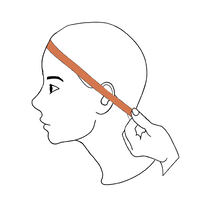
This is simply the measurement taken with a tape around your head.
Many women notice that this measurement becomes slightly smaller after complete hair loss because the tape now sits directly against the scalp instead of over the hair.
Correct Hat Size
The correct hat size is the size that allows the hat to sit exactly where it was designed to sit.
A well-fitting chemo hat should:
- Sit comfortably on the head without slipping
- Frame the face naturally
- Leave the eyes fully visible
- Cover the nape of the neck
- Provide the correct amount of crown depth
- Feel secure without feeling tight
These two measurements are not always the same.
Hair Does Much More Than Add Circumference
Hair doesn't simply increase your measured head circumference. It also occupies space inside the hat, creates natural grip between the hat and the scalp, and helps support the crown of the hat.
It also acts as a natural:
- Cushion
- Spacer
- Grip layer
When the hair disappears, the hat sits differently against the scalp.
The result is often:
- More internal space
- Less grip
- Less crown support
- A lower sitting position
This is why many women describe their hats as feeling oversized, even when the measured reduction in head circumference is relatively small.
Why Hat Sizing Is More Critical Than Most Clothing
Unlike T-shirts, dresses or jackets, hats have very little tolerance for sizing errors.
A shirt that is 2–3 cm too large will usually still look perfectly acceptable.
A hat is different.
A hat sits on top of your head, where gravity is constantly pulling it downward.
If a hat is only one size too large, it may:
- Sit too low on the forehead
- Partially cover the eyes
- Feel too deep
- Move around more easily
- Lose its intended shape
Unlike most clothing, a hat must also frame the face correctly.
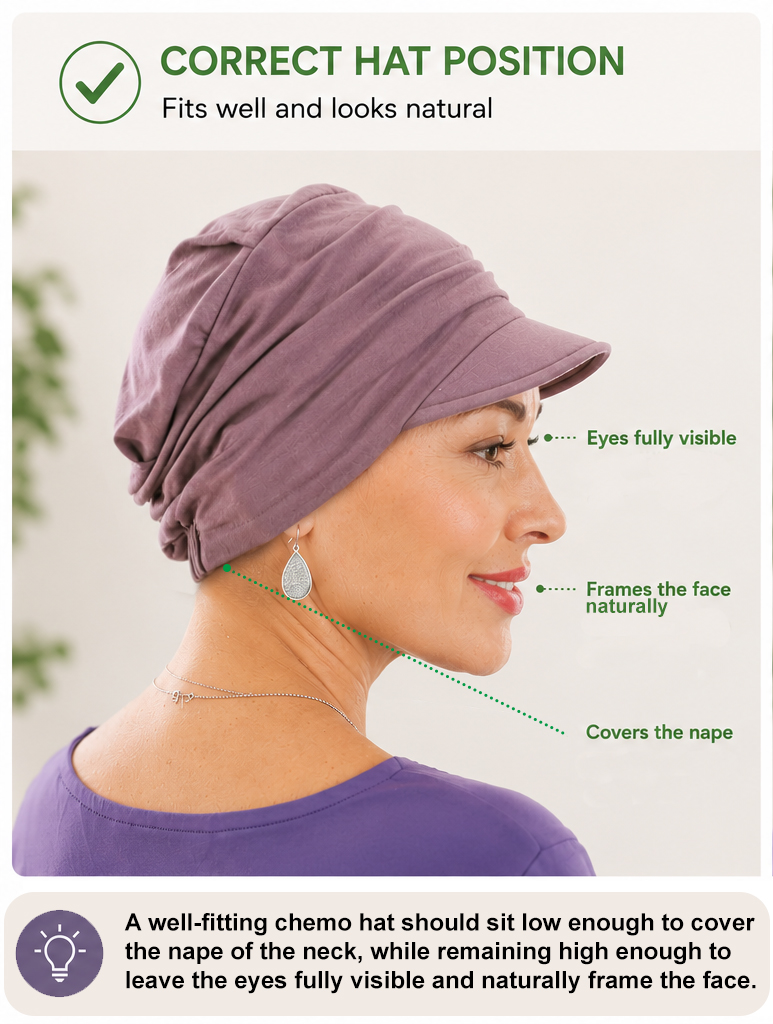 A well-fitting chemo hat should sit low enough to comfortably cover the nape of the neck, while remaining high enough to leave the eyes fully visible and naturally frame the face. If the hat sits too low, it may feel oversized and overwhelm the face. If it sits too high, it may not provide the intended coverage. Finding the correct sitting position is just as important as selecting the correct hat size.
For most women's hats, each size increases by approximately 1 cm in head circumference.
This means that even a relatively small change in practical fit can result in moving down one hat size.
What We've Observed After Fitting Thousands of Women
Although there is very little published research on how hair loss affects women's headwear sizing, our practical experience suggests that hair volume can have a significant influence on hat fit.
Based on many years of customer fittings, we have found that the following guide often provides a useful starting point.
|
Hair Volume |
Suggested Change |
|
|---|---|---|
| Very fine or flat hair | Little or no change | |
| Average hair | ↓ Around 0.5 cm | |
| Thick hair | ↓ Around 0.5–1 cm | |
| Very thick or curly hair | ↓ Around 1 cm or slightly more |
*These recommendations are based on Jas Fashion's practical fitting experience and customer feedback. This is a starting guide only. Individual head shape, hat design and personal fitting preferences may also influence the most comfortable size.
Why Does Hair Loss Change the Way Hats Fit?
More Internal Space
Hair occupies space inside the hat.
Once the hair is gone, there is simply more room inside.
Less Grip
Hair naturally creates friction between the scalp and the hat.
Without hair, many hats slide more easily and may feel less secure.
Less Crown Support
Hair naturally fills and supports part of the crown of a hat.
Without that support, the same hat may:
- Feel deeper
- Have excess room in the crown
- Sit lower on the head
- Feel slightly oversized
This is especially noticeable with structured hats such as bucket hats, cloche hats and sun hats.
A Lower Sitting Position
Without the cushioning effect of hair, the hat naturally sits closer to the scalp.
Many women describe this simply as:
"My head can swim in my hats."
The hat hasn't changed.
The way it sits on the head has.
Why the Reduction Isn't Simply the Difference in Head Circumference
Many women notice that their measured head circumference becomes slightly smaller after complete hair loss.
At first glance, it might seem logical to simply choose a hat based only on this smaller measurement.
However, chemo headwear is designed differently from many everyday fashion hats.
Unlike a baseball cap or visor, a chemo hat is designed to provide comfort, warmth and natural-looking coverage.
A well-fitting chemo hat should sit low enough to comfortably cover the nape of the neck, while remaining high enough to leave the eyes fully visible and naturally frame the face. If the hat sits too low, it may feel oversized and overwhelm the face. If it sits too high, it may not provide the intended coverage.
This is one of the reasons why our practical sizing recommendations are often less than the reduction suggested by a tape measure alone.
For example, a woman with thick hair may measure almost 1 cm smaller after complete hair loss. However, reducing the hat by the full measured difference may cause it to sit too high on the head and lose the intended coverage. In our experience, the best-fitting chemo hat is the one that sits in the correct position, not necessarily the one that matches the tape measure exactly.
After fitting thousands of women over many years, we've found that successful chemo headwear sizing is not simply about matching head circumference—it is about achieving the correct sitting position and overall appearance.
Every Woman's Experience Is Different
There is no single rule that applies to everyone.
The amount of change depends on factors such as:
- Hair thickness
- Hair density
- Hair length before treatment
- Head shape
- Hat style
- Fabric stretch
- Whether hair was tucked inside the hat before treatment
- Whether a wig or halo hair will be worn
This is why two women with exactly the same head circumference may require different hat sizes after hair loss.
An Area That Deserves More Research
Surprisingly, despite extensive research into chemotherapy-induced hair loss, there appears to be very little published research examining how hair volume changes the correct sizing of women's headwear.
Most studies focus on:
- Hair loss itself
- Scalp cooling
- Wig use
- Hair regrowth
- Quality of life
Very few investigate how hair loss changes the practical fit of hats.
As a company specialising in chemo headwear, we believe this is an important area for future research.
Questions such as:
- How much does hair volume influence the correct hat size?
- How much smaller should hats be after complete hair loss?
- How does hair density influence comfort and stability?
- How should hats be designed for women wearing wigs or halo hair?
- Can we develop an evidence-based sizing system for women's chemo headwear?
could help improve headwear design for women around the world.
Our Experience Continues to Grow
Every customer teaches us something new.
After helping thousands of women over many years, one observation continues to stand out:
Head circumference alone does not determine the correct chemo hat size.
Hair volume, head shape, fabric stretch and hat design all work together to determine whether a hat feels comfortable, secure and sits at the correct height.
In our experience, the correct hat size isn't simply the size that matches your head circumference—it's the size that allows the hat to sit where it was designed to sit.
We hope that one day these practical observations can be supported by formal scientific research and contribute to better sizing systems for women experiencing hair loss.
Our Recommendation
If you're unsure which size to choose after hair loss, we'd be delighted to help.
Rather than relying solely on your head circumference, we also consider:
- Whether you've completely lost your hair or are experiencing regrowth
- Whether you'll be wearing a wig or halo hair
- The style of headwear you're choosing
This allows us to recommend the size that is most likely to provide a comfortable, secure and confidence-boosting fit.
At Jas Fashion, we understand that every woman's hair loss journey is unique. That's why we offer a range of practical solutions to help achieve the right fit, including chemo headwear, bamboo hat liners that can improve the fit and comfort of your favourite hats, hat size reducers for hats that feel too loose, and accessories designed to support different stages of hair loss and hair regrowth.
Our goal is simple: to help every woman find headwear that fits comfortably, looks natural, and gives her the confidence to face each day.
Help Us Improve Women's Headwear Sizing
At Jas Fashion, we believe every woman's experience can help improve headwear for future patients.
If you have experienced hair loss due to chemotherapy, alopecia or another medical condition, we'd love to hear about your experience.
Your anonymous feedback may help us better understand how hair volume influences women's headwear sizing and contribute to future evidence-based research.
Author's Note
This article is based on Jas Fashion's practical experience fitting thousands of women experiencing hair loss over more than 15 years. The sizing guidance reflects real-world customer fittings and feedback and should not be interpreted as published scientific research. Every woman's hair, head shape and fitting preferences are unique.
Related Reading:
Finding the Perfect Fitting Headcovers
General Guide on Head Covers for Hair Loss
Chemo Must-have Headcovers and Styling Tips